With our 2016 project “BurkinAfrique – African Perspectives on Peace and Development,” we explored democracy and stability in Africa. Using the examples of Burkina Faso, Cameroon, and the Democratic Republic of the Congo, we asked what civil society engagement can achieve for democracy. The project included a Future Workshop in May and our AMK Symposium in November.
What it was about
Since the 1990s, more than 36 African countries had written term limits into their constitutions. Yet in half of the cases where presidents reached this limit, they tried to secure further terms through constitutional amendments. In nine countries, the governments’ terms of office were due to end between 2015 and 2017.
At our earlier events, there was a great deal of uncertainty: What happens when authoritarian states democratize? What role does foreign influence play, and what does that mean for a country’s stability? This uncertainty was also linked to the Arab Spring. In North Africa, the uprisings had led to military interventions and civil wars – and in Libya, to yet another failed state.
Through our projects, we want to help Africa prevent crises or resolve them itself – if necessary, also with peacekeeping troops. BurkinAfrique also aimed to involve the African diaspora and refugees more closely in development education.
African problems – African solutions.
The guiding idea of our peace work
Three countries in focus
Burkina Faso
In 2014, a great wave of protest in the “land of upright people” toppled the president. He had ruled for 27 years and wanted to stay in power through yet another constitutional amendment. Afterward, the presidential guard loyal to him staged a coup. With the support of the military and renewed mass protests, the coup was pushed back. We asked: How can protest prevent an unconstitutional hold on power without jeopardizing stability? And what can other countries learn from Burkina Faso?
Cameroon
A constitutional amendment in 2008 allowed unlimited terms of office and granted the president immunity beyond his time in office. This deepened political lethargy. After decades under the same president, strong opposition structures were lacking – in political parties as well as in civil society. At the same time, despite some 200 ethnic groups and the division into an Anglophone and a Francophone part, the country had a certain degree of stability. Our Cameroon discussion evenings had shown that democracy is a work in progress, but traditional structures often stand in its way.
Democratic Republic of the Congo
Many obstacles stood in the way of lasting peace. At earlier AMK events, more than 40 participants, many of them from the Congolese diaspora, agreed: the poor security situation despite 15 years of the UN mission MONUSCO, the humanitarian emergency, and the upcoming presidential election posed enormous challenges for the country. Many experts feared that if the president held on to power, the country would sink even deeper into poverty and violence. Diplomats from the DR Congo who took part were open to closer cooperation with the diaspora.
Future Workshop and symposium
- May 21 Future Workshop “BurkinAfrique” Input from experts and group work at the August-Bebel-Institut
- November 5 AMK Symposium “Democracy and Stability in Africa” Panel discussion with experts from academia, civil society, and politics
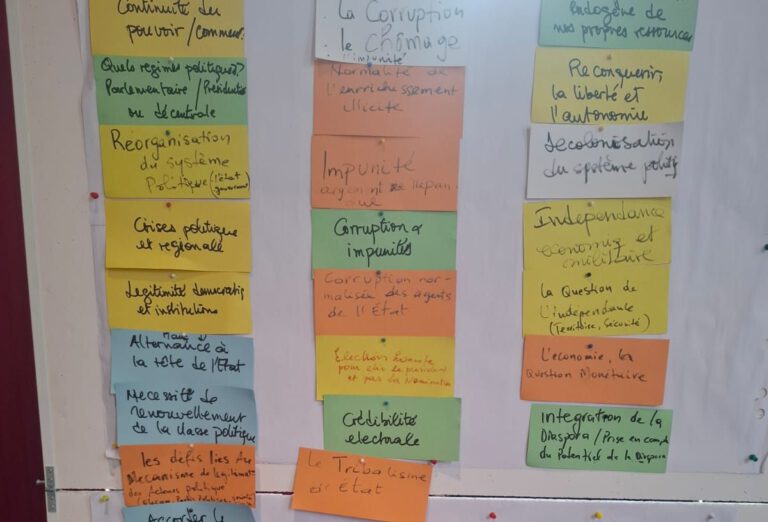
In the full-day Future Workshop, input from experts was followed by group work, for example on the consequences of the Arab Spring and on how political change affects stability. The aim was to gather criticism, needs, and ideas, to find ways of putting them into practice, and to reflect on an African democracy.
Our annual symposium had focused on Mali in 2014 and on the Central Africa region in 2015. In 2016, it addressed democracy and stability in Africa and the causes of displacement on the continent. Unlike the Future Workshop, it brought experts from academia, civil society, and politics together for a panel debate. According to the program, the speakers included an activist from Burkina Faso, the Ambassador of the Democratic Republic of the Congo, and an academic from Freie Universität Berlin.
The symposium was also part of our project “Wedding Network for Intercultural Dialogue.” In 2017, our symposium on religion and politics built on BurkinAfrique.
The project was funded by Engagement Global on behalf of the German Federal Ministry for Economic Cooperation and Development (BMZ), by the Berlin State Office for Development Cooperation (Landesstelle für Entwicklungszusammenarbeit, LEZ), and by Brot für die Welt (Bread for the World).