Crises and conflicts hold back the development of countries. This observation was the starting point for our 2015 project “Peace and Development in the Central Africa Region.” With four discussion evenings and a symposium, we wanted to inform people about the background to the crises and strengthen African communities in Berlin.
200+
people reached
4
discussion evenings
3
workshops at the symposium
What it was about
The Central Africa region includes these countries:
- Chad
- Cameroon
- Republic of the Congo
- Democratic Republic of the Congo
- Gabon
- Equatorial Guinea
- Rwanda
- Central African Republic
Conflicts were part of everyday life there and severely held back development. Boko Haram in northern Cameroon and religious conflicts in the Central African Republic raised fears of new unrest. But we deliberately looked not only at the wars, but also at peace, development, and solutions. This opened up new perspectives.
Africa has long mattered to the US, Europe, and China – for security and counterterrorism, but also for energy and raw materials. Examples include the US regional military command (AFRICOM) and the African Peace and Security Architecture (APSA). The region’s raw materials often end up in technologies used mainly by the Western world. Even so, few people in Germany took an interest in war and suffering in Central Africa.
Guiding questions
- What are the causes of instability – and to what extent have German and European interests contributed to it?
- Can the military strategies and economic interests of powerful states create peace in the long term?
- Is lasting peace even in their interest?
- What realistic ways forward are there?
- What role does the African diaspora play in the peace process, for example in the DR Congo?
The situation of the people in the refugee camp in Berlin-Kreuzberg showed just how global these crises are. We felt confirmed by the United Nations’ 2030 Agenda, adopted in September 2015. Its preamble states: there can be no sustainable development without peace and no peace without sustainable development.
The program
- September and October Four discussion evenings at the Nelson Mandela restaurant on September 4 and 11 and on October 2 and 9
- November 21 Symposium at the August-Bebel-Institut Panel discussion, three parallel workshops, and open discussions
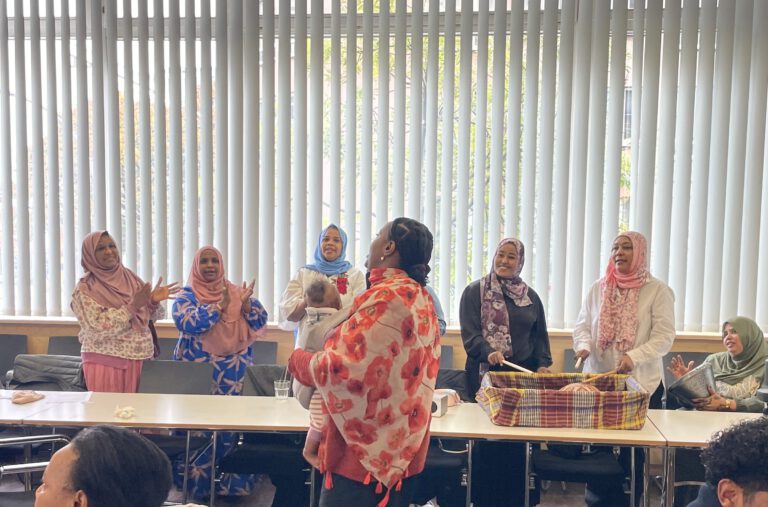
The discussion evenings offered a low-threshold opportunity to learn and join the debate. Participants included representatives of the Congolese embassy, members of African communities and associations, and interested citizens. Topics included the Democratic Republic of the Congo and the role of the diaspora. A Green Party politician from the Berlin House of Representatives’ Committee on Internal Affairs, Security and Order took part in one of the evenings. She promised to take the topic “Conflict, Displacement, Peacebuilding” to the relevant committees.
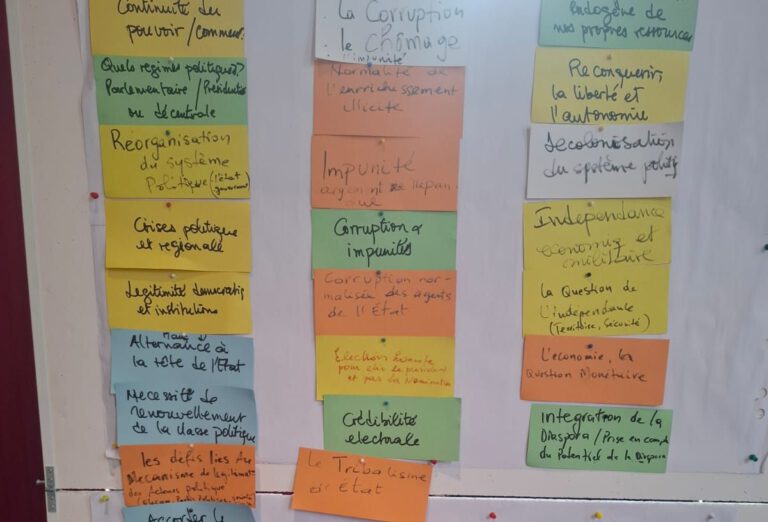
At the symposium, experts from politics, academia, diplomacy, and non-governmental organizations analyzed developments in the region. The panel and the audience then split into three workshops. In the workshop “The Role of the Diaspora in the Peace Process and in Society,” Mutoto e.V. and Bagandou e.V. presented their projects – such as prevention work in schools against the radicalization of young people and the expansion of a school in Bagandou. Representatives of the Konrad-Adenauer-Stiftung also took part.
Experts from the diaspora
Experts from these organizations contributed their knowledge – including three representatives of the Congolese embassy:
- Mutoto e.V.
- FCA e.V.
- Bagandou e.V.
- Flüchtlingsinitiative Berlin-Brandenburg (FIBB e.V.)
- NARUD e.V.
- Embassy of the Democratic Republic of the Congo
This shows that the development engagement of people of African descent in Berlin is growing. It was precisely this civic engagement that we wanted to link with advocacy on development policy.
What we achieved
- We raised awareness of the topic among the African diaspora, an important target group for us, and discussed its role in the peace process.
- Many came away with a more nuanced picture of the region. Afterward, they were able to assess politics in African countries and the actions of industrialized countries more critically and realistically.
- Together with political actors and interested citizens, we looked for solutions and expanded the networking between those involved.
The project was funded by the German Federal Ministry for Economic Cooperation and Development (BMZ) and the Berlin State Office for Development Cooperation (LEZ).