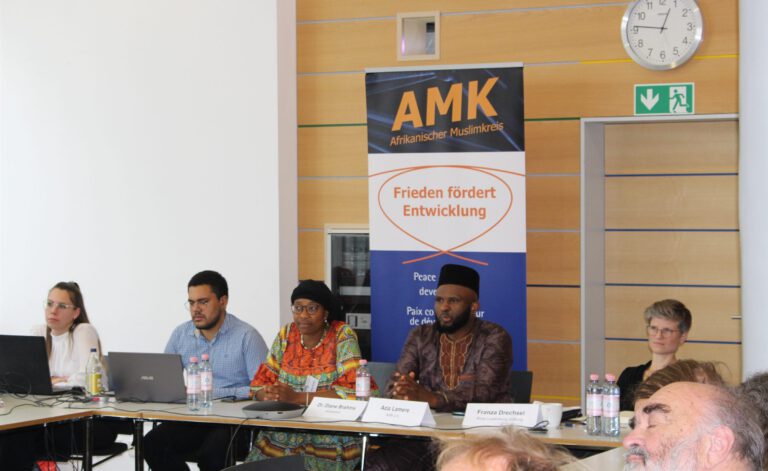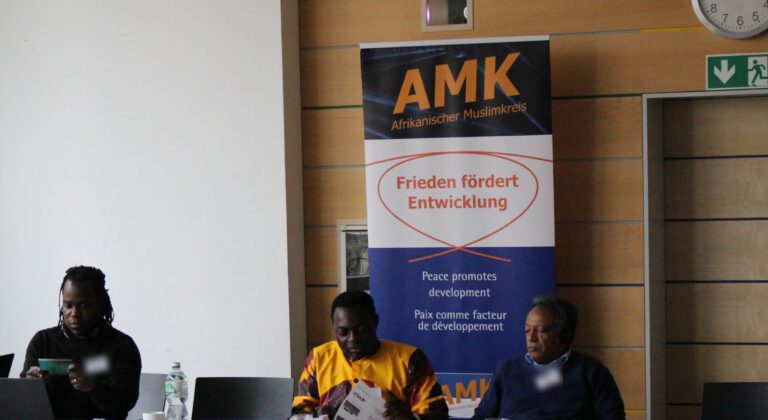
On Saturday, October 25, 2025, we hosted our second symposium on the war in Sudan. At the Kurt-Schumacher-Haus in Berlin-Wedding and online, experts and representatives of the Sudanese diaspora discussed two questions: Why have all peace efforts failed so far – and how can the forgotten war be ended?
about 60
guests on site
up to 48
online participants
3
talks, each with a discussion
What it was about
In 2019, Omar al-Bashir’s long-standing regime was overthrown in Sudan. A transition to democracy and stability seemed possible. But since April 2023, the army and the RSF militia have been fighting each other – at the expense of the population. At the time of the symposium, millions of people were suffering from hunger, and millions were fleeing violence. Yet the war seemed to have been forgotten by the international public.
The symposium was part of our two-year project “Peace and Development in Sudan: Are There Ways Out of the Nightmare?” It continued the discussion begun at our first Sudan symposium in 2024. We wanted to explore ways out of the civil war and show what the African diaspora can contribute.
Guiding questions
- Why, and because of whom, have peace efforts failed so far – in Sudan itself and internationally?
- What could a lasting solution to the conflict look like, and who could initiate and enforce it?
- How can reconstruction, stabilization, and democratization be set in motion in a sovereign Sudan?
- How can women’s organizations and the democracy movement, which helped bring down al-Bashir, gain an important role in peace negotiations?
- How can Germany, the EU, and the African Union support this?
- What is the Sudanese diaspora in Germany doing, and how can the wider African diaspora support it?
The program
- 10:00 a.m. Welcome by AMK e.V.
- 10:10 a.m. Why the peace negotiations in Sudan are failing Talk by a Sudanese women’s and human rights activist
- 11:00 a.m. International mediation in Sudan: lessons and perspectives Talk by a researcher from the Stiftung Wissenschaft und Politik (SWP – German Institute for International and Security Affairs)
- 12:10 p.m. The role of the military and paramilitaries in Sudan Talk by the chairman of the board of Sudanclub e.V.
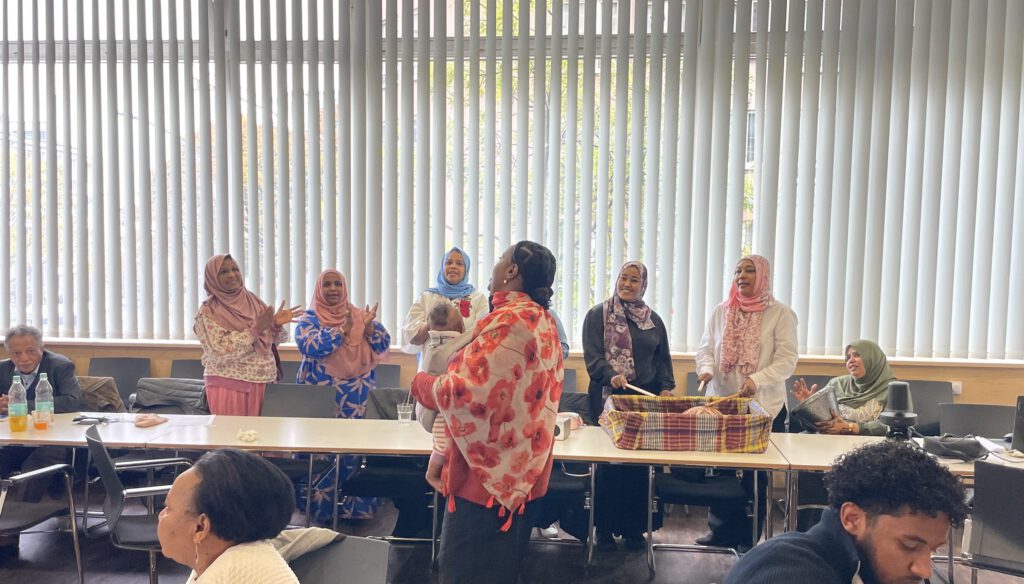
- 1:00 p.m. Lunch break with a Sudanese buffet and live Sudanese music
- 2:00–4:00 p.m. Panel and open audience discussion with the speakers and other guests
These organizations and voices were represented on the panel and in the talks:
- a Sudanese women’s and human rights activist
- Stiftung Wissenschaft und Politik (SWP)
- Sudanclub e.V.
- National Movement for Building and Development (NMBD)
- Sudan Uprising Germany
- MOWATIN: Gulf Centre for Democratic Development, London
- a historian and Sudan expert
What the talks covered
The first talk traced the war between the Sudanese army and the RSF since April 2023. According to UN figures, more than twelve million people had been displaced and 25 million needed humanitarian aid. The talk called for an inclusive negotiation process involving civil society, women, and young people, and for a binding framework for sharing power.
The second talk counted some twelve international mediation initiatives since April 2023 – from the Jeddah platform, IGAD, and the African Union to the London conference in April 2025. The lessons the speaker drew included fragmented conflict parties, the misleading image of the “two generals,” and competition between mediators.
The third talk examined how the military and paramilitaries in Sudan were able to gain so much political and economic power – and how their independence from politics and society can be overcome.
Meeting on site and online
The contributions were interpreted simultaneously between German and English. Guests from abroad also joined online, such as a Sudanese association from Switzerland. The lunch break left time for conversation over a Sudanese buffet and live music – two things guests particularly praised on their feedback forms.
The symposium was funded by Engagement Global on behalf of the German Federal Ministry for Economic Cooperation and Development (BMZ) and by the Berlin Senate Department for Economics, Energy and Public Enterprises through the Berlin State Office for Development Cooperation (LEZ).