How can Cameroon achieve a peaceful and democratic transition that includes everyone in the country? This question was at the heart of our Future Workshop on Saturday, September 5, 2026. For a full day, participants at the Haus der Jugend in Berlin-Wedding and online worked on visions and first steps.
What it was about
Cameroon is at a political turning point. Its system of state and government is heavily tailored to the office of the president. At the same time, key problems remain unresolved: the Anglophone crisis, regional inequalities, and the question of how all population groups can be politically represented and involved.
We deliberately chose not to talk about parties or individual politicians. Instead, the focus was on what a democratic transformation could look like – and which steps could open the way to a possible Third Republic. The workshop was designed to bring people together across political camps: a space for open, respectful dialogue, not a party-political forum. The working languages were French and English.
In doing so, we built on our first Future Workshop on Cameroon in 2019.
Guiding questions
- How can the highly centralized administrative and presidential system be further developed or overcome?
- Which forms of decentralization and power-sharing could reduce regional inequalities while strengthening national cohesion?
- Which African forms of power-sharing and consensus democracy could be of interest to Cameroon?
- How could a process toward a new constitution and a Third Republic be set in motion?
- What role can the Cameroonian diaspora play in this?
- How can the mistrust between Cameroon’s political institutions and parts of the diaspora be overcome?
How we worked
The Future Workshop was a shared process of thinking and working. The focus was not on ready-made answers but on ideas, visions, and concrete options for action. Each step built on the one before:
Gathering challenges
In the plenary session, we gathered the key challenges for a democratic transformation, grouped them into topic areas, and set the topics for the working groups.
Developing visions
Working groups created pictures of the future: What could a democratic, peaceful, and inclusive Cameroon look like – positive, yet realistic?
Finding the way
Next came the question: How do we get there? The groups developed strategies for the transition and concrete measures that could be started right away.
Bringing the results together
To close, we brought the results together and reflected on them as a group. There was also room for feedback and further ideas.
Topics and results
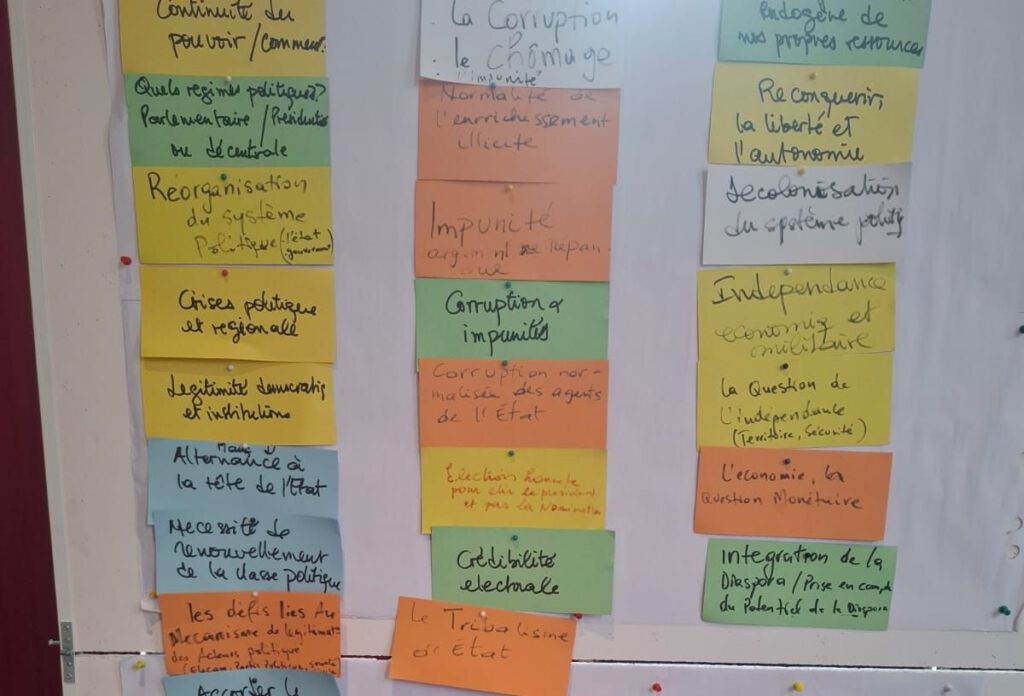
The very first step showed how wide-ranging the challenges are. These were among the topic areas that took shape on the pinboard:
- Redefining the political system
- Corruption and impunity
- Independence and decolonization
- Identity and national values
- Decentralization or federalism
- Education and the teaching of history
- Involving the diaspora
Two examples from the working groups:
Independence and decolonization
This group understood independence in a broad sense: economic, cultural, and scientific, but also in education and health. Its recommendations included processing raw materials within the country and reforming general and vocational education.
Identity and the fight against corruption
This group drew up a roadmap built around the vision “CAM 2045.” It describes four transformations – moral, institutional, economic, and cultural – and proposes immediate measures for greater transparency and a shared national identity.
Who took part
We invited members of the Cameroonian diaspora, of other African diaspora communities facing similar challenges, and everyone committed to Cameroon’s peaceful development. Via Zoom, people in Cameroon and other African countries could also join the discussion.
In the feedback forms, participants praised the good organization, the interesting topics, and the open, respectful exchange. One suggestion: to offer similar workshops in family centers and African community meeting places as well.
The Future Workshop was funded by Engagement Global on behalf of the German Federal Ministry for Economic Cooperation and Development (BMZ) and by the Berlin Senate Department for Economics, Energy and Public Enterprises.