Are conflicts in Africa really religious – or are there economic, political, and social causes behind them? In 2017, we explored these questions in three panel discussions and at our AMK Symposium on December 2. The focus was on the role of the diaspora.
3
panel evenings in Wedding
102
guests at the panels
89
symposium participants
What it was about
In sub-Saharan Africa, Christianity, Islam, and traditional spirituality meet. Local warmongers can easily exploit these differences for stigmatization and retaliation. In Germany, too, religion is instrumentalized – right down to Berlin’s neighborhoods.
The project built on “BurkinAfrique – African Perspectives on Peace and Development” from 2016.
Guiding questions
- What economic, political, and social causes lie behind seemingly religious conflicts?
- What problems do religious tensions create for development work?
- What role can religious actors, communities, and the diaspora play in building peace?
The panel series
- October 3, 2017 “The Role and Function of Religion and Religious Institutions in Today’s Society” Arresalah Mosque, on Open Mosque Day
- October 27, 2017 “Religious and Ethnic Prejudice Within the Migrant Community” Haus der Jugend youth center at Nauener Platz
- November 17, 2017 “Religious Extremism and the Exploitation of Religious Tensions in Europe” Haus der Jugend youth center at Nauener Platz
A total of 102 people attended the three evenings. The panels were also part of our project “Wedding Network for Intercultural Dialogue”. The speakers were representatives of mosques, churches, and initiatives, including:
- Inssan e.V.
- Alkawakibi e.V.
- Protestant Church of Berlin-Brandenburg-Silesian Upper Lusatia
- ForumDialog/House of One
- Alevi Community of Berlin
- Bürgerplattform Wedding/Moabit
- EPIZ Berlin
- ReachOut
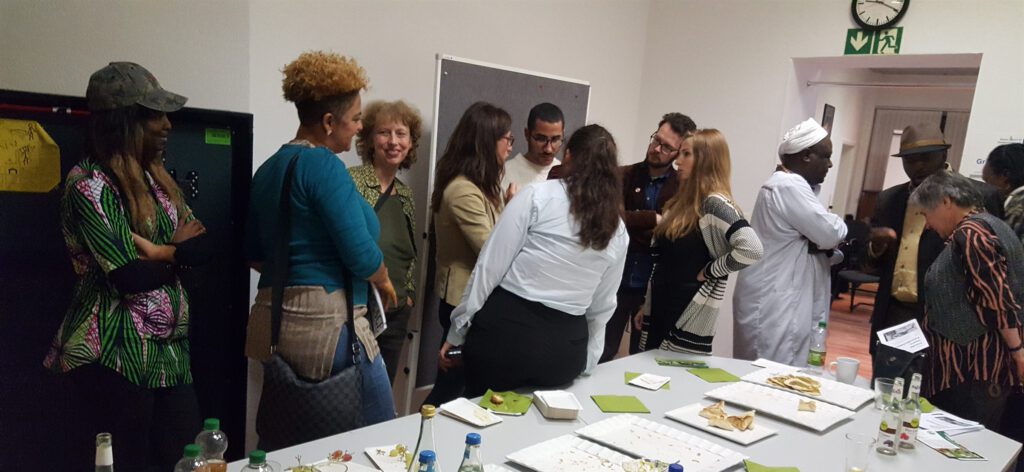
The symposium on December 2, 2017
The project concluded with the symposium at the Kurt-Schumacher-Haus in Berlin-Wedding, attended by 89 participants. To open, the Embassy of Nigeria spoke about cooperation between governments and the diaspora for peace and sustainable development. Four talks followed:
Churches without missionaries
The development work of African churches founded without missionaries – a talk from the Faculty of Theology at Humboldt-Universität zu Berlin.
Faith-based aid organizations
Experiences of faith-based aid organizations, presented by EIRENE International Christian Peace Service.
Diaspora and peace
The role the diaspora can play in building peace – from the perspective of the city of Ludwigsburg’s municipal development cooperation.
Keeping the peace, exporting arms?
Are safeguarding peace and exporting arms a contradiction? A talk from the Otto Suhr Institute at Freie Universität Berlin.
In the afternoon, the discussion continued in three panels:
- religious tensions as a cause of displacement in the Central African Republic, Chad, Nigeria, and Cameroon
- the shift to the right, Islamophobia, and religious extremism
- the “Marshall Plan with Africa”
At the symposium, we also presented our project “L’avenir c’est ici! – The Future Is Here!” in Cameroon.
Results
- Tensions between members of different religions do not arise from the religions themselves but from political manipulation in power struggles.
- Ways out of such conflicts include interfaith dialogue, joint projects by Christians and Muslims, and the involvement of religious leaders.
- Countering everyday racism requires ongoing awareness-raising and greater participation of people with a migration background.
- The “Marshall Plan with Africa” was criticized for having been drawn up without Africans, the diaspora, and civil society.
Almost all of the experts had a migration background. At each event, at least half of the audience were also people with a migration background.
The project was funded by Engagement Global on behalf of the German Federal Ministry for Economic Cooperation and Development (BMZ), by the Berlin State Office for Development Cooperation (LEZ) via the Stiftung Nord-Süd-Brücken, and by Brot für die Welt (Bread for the World).