Kamerun – Auf dem Weg zu einer 3. Republik?
Perspektiven und Szenarien für eine demokratische Transformation
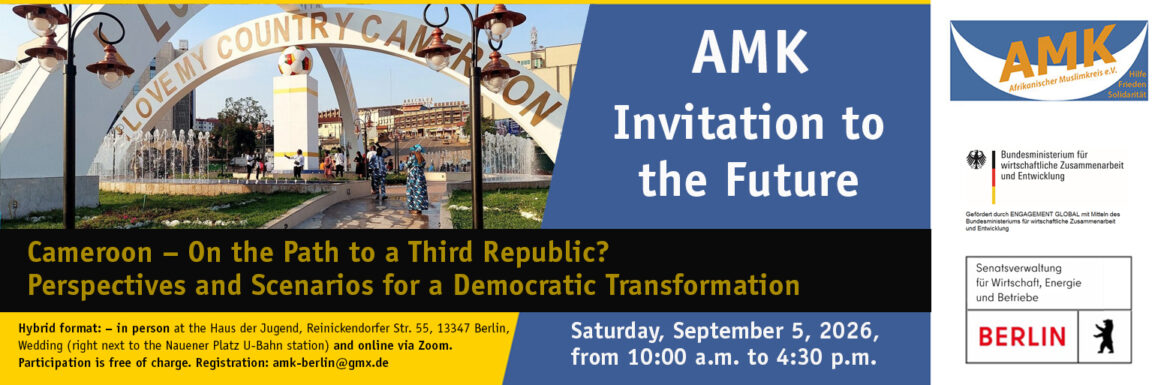
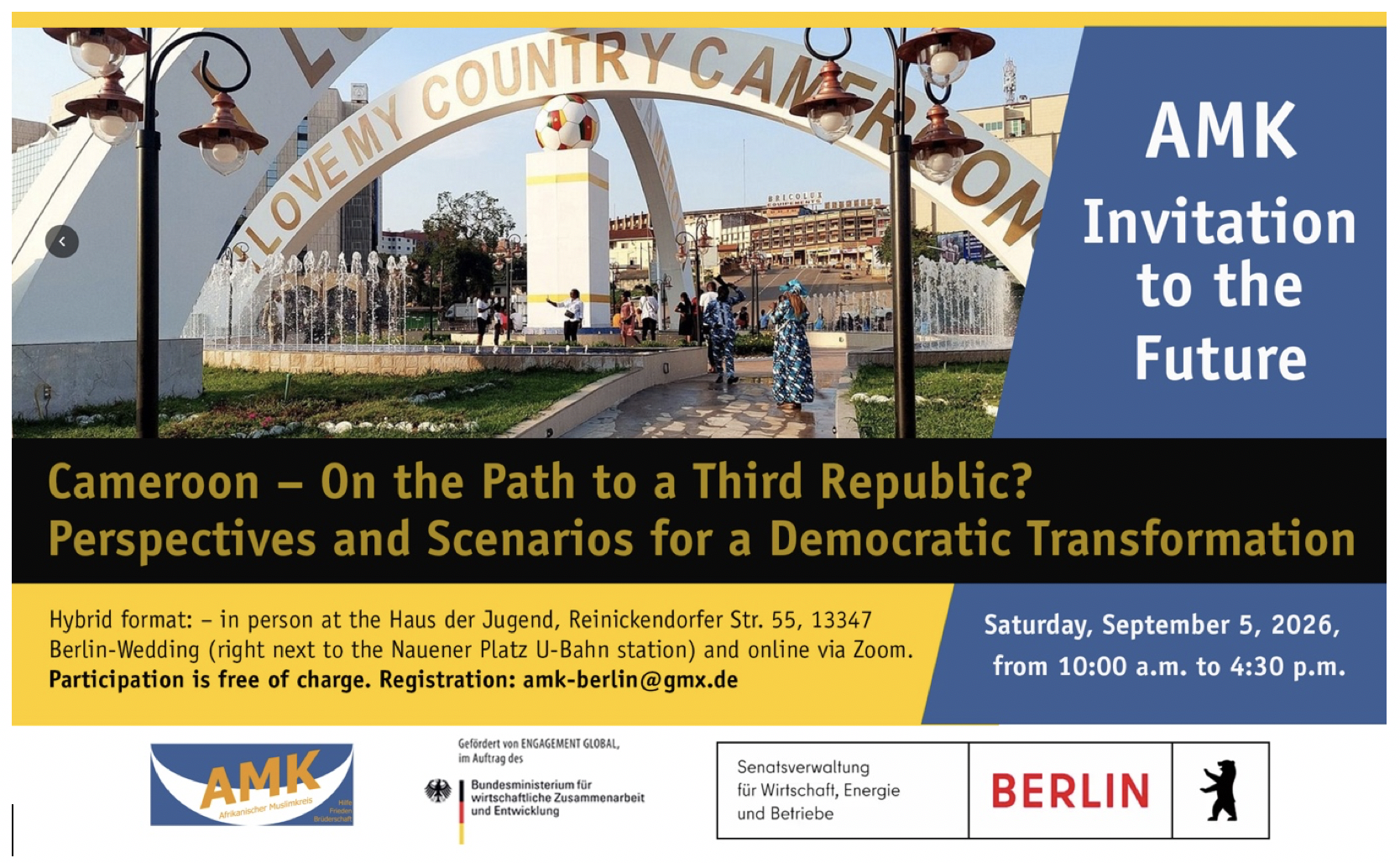
Der Afrikanische Muslimkreis e.V. (AMK) lädt herzlich zur
Zukunftswerkstatt „Kamerun – Auf dem Weg zu einer 3. Republik?“
am Samstag, 5. September 2026, von 10:00 bis 16:30 Uhr ein.
Die Veranstaltung findet hybrid statt: – vor Ort im Haus der Jugend, Reinickendorfer Str. 55, 13347 Berlin-Wedding (direkt am U-Bahnhof Nauener Platz) und online über Zoom.
Die Arbeitssprachen sind Französisch und Englisch.
Die Teilnahme ist kostenlos.
Anmeldung: amk-berlin@gmx.de
Gemeinsam über Kameruns Zukunft nachdenken
Kamerun steht an einem historischen und politisch herausfordernden Wendepunkt. Die politische Situation ist geprägt von tiefen gesellschaftlichen Spannungen, ungelösten Konflikten und wachsenden Unsicherheiten über die Zukunft des politischen Systems.
Das kamerunische Staats- und Regierungssystem ist in hohem Maße auf das Amt des Präsidenten zugeschnitten. Gleichzeitig bleiben zentrale politische Herausforderungen ungelöst – darunter insbesondere die anglophone Krise, regionale Ungleichheiten und die Frage nach einer angemessenen politischen Repräsentation und Beteiligung aller Bevölkerungsgruppen.
Vor diesem Hintergrund stellt sich eine entscheidende Frage:
Wie kann ein friedlicher und demokratischer Übergang gestaltet werden, der alle Kamerunerinnen und Kameruner einbezieht und neue gemeinsame Perspektiven für das Land eröffnet?
Mit unserer Zukunftswerkstatt möchten wir dieser Frage gemeinsam nachgehen.
Wir wollen nicht über Parteien oder einzelne politische Akteure diskutieren, sondern gemeinsam darüber nachdenken, wie eine demokratische Transformation Kameruns aussehen könnte – und welche politischen, gesellschaftlichen und institutionellen Schritte notwendig wären, um den Weg zu einer möglichen 3. Republik zu eröffnen.
Eure Perspektiven sind gefragt
Die Zukunftswerkstatt ist als gemeinsamer Denk- und Arbeitsprozess gestaltet. Im Mittelpunkt stehen nicht fertige Antworten, sondern Ideen, Visionen und konkrete Handlungsmöglichkeiten.
In drei aufeinander aufbauenden Phasen werden wir gemeinsam arbeiten:
1. Herausforderungen erkennen und priorisieren
Zu Beginn sammeln und diskutieren wir zentrale Herausforderungen für eine demokratische Transformation Kameruns. Gemeinsam werden wir diese priorisieren und zu drei zentralen Themenfeldern bündeln.
2. Visionen für eine 3. Republik entwickeln
In drei Arbeitsgruppen entwickeln wir auf dieser Grundlage Zukunftsziele und Visionen:
Wie könnte ein demokratisches, friedliches und inklusives Kamerun der Zukunft aussehen?
3. Vom Zukunftsbild zum konkreten Handeln
Anschließend geht es um die entscheidende Frage:
Wie kommen wir dorthin?
Die Arbeitsgruppen entwickeln mögliche Übergangsstrategien, konkrete Maßnahmen und erste Schritte, die zur Verwirklichung der erarbeiteten Zukunftsziele beitragen könnten.
Zum Abschluss werden die Ergebnisse zusammengeführt und gemeinsam reflektiert. Dabei gibt es auch Raum für Feedback und weitere Ideen.
Fragen, die uns beschäftigen können
Unter anderem wollen wir uns mit Fragen auseinandersetzen wie:
- Wie kann das stark zentralisierte Verwaltungs- und Präsidialsystem weiterentwickelt oder überwunden werden?
- Welche Formen von Dezentralisierung und Machtteilung könnten regionale Ungleichheiten verringern und zugleich den nationalen Zusammenhalt stärken?
- Wie lässt sich verhindern, dass Dezentralisierung bestehende Ungleichheiten und gesellschaftliche Spannungen weiter verschärft?
- Wie können nationale Einheit, politische Teilhabe und staatliche Souveränität miteinander verbunden werden?
- Welche institutionellen Mechanismen braucht es, damit Konflikte während eines Transformationsprozesses friedlich und lösungsorientiert bearbeitet werden können?
- Was können wir aus bestehenden demokratischen Modellen lernen – und wo müssen wir neue, auf die kamerunische und afrikanische Realität zugeschnittene Wege entwickeln?
- Welche Formen afrikanischer Machtteilung und Konsensdemokratie könnten für Kamerun interessant sein?
- Wie könnte ein Prozess zur Erarbeitung einer neuen Verfassung und zur Etablierung einer 3. Republik angestoßen werden?
- Welche Rolle kann die kamerunische Diaspora bei einem solchen Transformationsprozess spielen?
- Wie kann die Vielfalt der Diaspora konstruktiv einbezogen werden?
- Wie kann die Diaspora dazu beitragen, Lösungen zu fördern, statt gesellschaftliche und politische Konflikte weiter zu verschärfen?
- Wie kann das bestehende Misstrauen zwischen politischen Institutionen Kameruns und Teilen der Diaspora überwunden werden?
Diese Fragen sind nur ein Ausgangspunkt. Welche Herausforderungen und Chancen seht ihr? Welche Ideen, Erfahrungen und Visionen bringt ihr mit?
Genau dafür bietet die Zukunftswerkstatt Raum.
Wer ist eingeladen?
Die Zukunftswerkstatt richtet sich insbesondere an:
- Mitglieder der kamerunischen Diaspora,
- Mitglieder anderer afrikanischer Diaspora-Gemeinschaften, die mit ähnlichen politischen und gesellschaftlichen Herausforderungen konfrontiert sind,
- Menschen in Kamerun und anderen afrikanischen Ländern, die sich an der Diskussion beteiligen möchten,
- sowie alle Interessierten, die sich für die demokratische und friedliche Entwicklung Kameruns engagieren.
Die Teilnahme ist ausdrücklich lagerübergreifend gedacht. Wir möchten Menschen zusammenbringen, die bereit sind, respektvoll zuzuhören, unterschiedliche Perspektiven auszuhalten und gemeinsam nach konstruktiven Lösungen zu suchen.
Die Zukunftswerkstatt versteht sich daher nicht als parteipolitisches Forum, sondern als Raum für offenen Dialog, gemeinsames Nachdenken und konkrete Zukunftsgestaltung.
Seid dabei und gestaltet mit!
Die Zukunft Kameruns wird nicht allein durch politische Institutionen gestaltet. Sie hängt auch davon ab, ob Bürgerinnen und Bürger, Zivilgesellschaft, Diaspora und gesellschaftliche Akteure bereit sind, gemeinsam über neue Wege nachzudenken.
Wir laden euch ein, eure Perspektiven einzubringen, kontroverse Fragen zu diskutieren, Visionen zu entwickeln und gemeinsam erste Schritte in Richtung einer friedlichen und demokratischen Transformation Kameruns zu entwerfen.
Anmeldung
Samstag, 5. September 2026 | 10:00–16:30 Uhr
Hybrid: vor Ort in [Ort ergänzen] und online über Zoom
Arbeitssprachen: Französisch und Englisch
Anmeldung per E-Mail: amk-berlin@gmx.de
Bitte gebt bei der Anmeldung an, ob ihr vor Ort oder online über Zoom teilnehmen möchtet.
Wir freuen uns auf eure Perspektiven, eure Ideen und einen offenen, konstruktiven Austausch über die Zukunft Kameruns.
———————————————————————-
Invitation to the Future Workshop
Cameroon – On the Path to a Third Republic? Perspectives and Scenarios for a Democratic Transformation
The African Muslim Circle (AMK) cordially invites you to the
“Cameroon – On the Path to a Third Republic?”
on Saturday, September 5, 2026, from 10:00 a.m. to 4:30 p.m.
The event will take place in a hybrid format: – in person at the Haus der Jugend, Reinickendorfer Str. 55, 13347 Berlin-Wedding (right next to the Nauener Platz U-Bahn station) and online via Zoom.
The working languages are French and English.
Participation is free of charge. Registration: amk-berlin@gmx.de
Hybrid: in person in [add location] and online via Zoom
Working languages: French and English
Please indicate when registering whether you’d like to participate in person or online via Zoom.
We look forward to hearing your perspectives and ideas and to an open, constructive discussion about the future of Cameroon.
Reflecting Together on Cameroon’s Future
Cameroon stands at a historic and politically challenging turning point. The political situation is marked by deep social tensions, unresolved conflicts, and growing uncertainties about the future of the political system.
Cameroon’s system of government is heavily centered on the office of the president. At the same time, key political challenges remain unresolved—including, in particular, the Anglophone crisis, regional inequalities, and the question of adequate political representation and participation for all segments of the population.
Against this backdrop, a crucial question arises:
How can a peaceful and democratic transition be shaped that includes all Cameroonians and opens up new shared prospects for the country?
Through our Future Workshop, we would like to explore this question together.
We do not want to discuss political parties or individual political actors, but rather to reflect together on what a democratic transformation of Cameroon might look like—and what political, social, and institutional steps would be necessary to pave the way for a possible Third Republic.
We want to hear your perspectives
The Future Workshop is designed as a collaborative process of reflection and work. The focus is not on ready-made answers, but on ideas, visions, and concrete courses of action.
We will work together in three phases that build on one another:
1. Identifying and Prioritizing Challenges
To begin, we’ll identify and discuss key challenges for a democratic transformation of Cameroon. Together, we’ll prioritize these and group them into three central thematic areas.
2. Developing visions for a Third Republic
In three working groups, we will use this foundation to develop future goals and visions:
What might a democratic, peaceful, and inclusive Cameroon of the future look like?
3. From a Vision of the Future to Concrete Action
Next, we’ll address the crucial question:
How do we get there?
The working groups will develop potential transition strategies, concrete measures, and initial steps that could contribute to achieving the future goals we’ve established.
Finally, the results will be compiled and discussed collectively. There will also be time for feedback and additional ideas.
Questions that may occupy our minds
Among other things, we want to address questions such as:
- How can the highly centralized administrative and presidential system be further developed or overcome?
- What forms of decentralization and power-sharing could reduce regional inequalities while simultaneously strengthening national cohesion?
- How can we prevent decentralization from further exacerbating existing inequalities and social tensions?
- How can national unity, political participation, and state sovereignty be reconciled?
- What institutional mechanisms are needed to ensure that conflicts during a transformation process can be addressed peacefully and in a solution-oriented manner?
- What can we learn from existing democratic models—and where do we need to develop new approaches tailored to the realities of Cameroon and Africa?
- What forms of African power-sharing and consensus democracy might be of interest to Cameroon?
- How could a process to draft a new constitution and establish a Third Republic be initiated?
- What role can the Cameroonian diaspora play in such a transformation process?
- How can the diversity of the diaspora be constructively incorporated?
- How can the diaspora help promote solutions rather than further exacerbate social and political conflicts?
- How can the existing mistrust between Cameroon’s political institutions and parts of the diaspora be overcome?
These questions are just a starting point. What challenges and opportunities do you see? What ideas, experiences, and visions do you bring to the table?
That is exactly what the Future Workshop is designed to facilitate.
Who is invited?
The Future Workshop is aimed in particular at:
- Members of the Cameroonian diaspora,
- Members of other African diaspora communities facing similar political and social challenges,
- People in Cameroon and other African countries who would like to participate in the discussion,
- as well as anyone interested in promoting the democratic and peaceful development of Cameroon.
Participation is explicitly intended to be nonpartisan. We want to bring together people who are willing to listen respectfully, tolerate different perspectives, and work together to find constructive solutions.
The Future Workshop is therefore not intended as a partisan forum, but rather as a space for open dialogue, shared reflection, and concrete planning for the future.
Join us and help shape the future!
Cameroon’s future is not shaped by political institutions alone. It also depends on whether citizens, civil society, the diaspora, and social actors are willing to think together about new paths forward.
We invite you to share your perspectives, discuss controversial issues, develop visions, and work together to outline the first steps toward a peaceful and democratic transformation of Cameroon.
——————————————–
Invitation à l’atelier sur l’avenir
Cameroun – Vers une 3e République ? Perspectives et scénarios pour une transformation démocratique
L’Association des musulmans d’Afrique (AMK) vous invite cordialement à l‘
l’atelier sur l’avenir « Cameroun – Vers une 3e République ? »
le samedi 5 septembre 2026, de 10 h 00 à 16 h 30.
L’événement se déroulera en format hybride : – sur place à la Haus der Jugend, Reinickendorfer Str. 55, 13347 Berlin-Wedding (juste à côté de la station de métro Nauener Platz) et en ligne via Zoom.
Les langues de travail sont le français et l’anglais.
Samedi 5 septembre 2026 | 10 h 00 – 16 h 30
Hybride : sur place à [compléter le lieu] et en ligne via Zoom
Langues de travail : français et anglais
Inscription par e-mail : amk-berlin@gmx.de La participation est gratuite.
Veuillez préciser lors de votre inscription si vous souhaitez participer sur place ou en ligne via Zoom.
Nous nous réjouissons de découvrir vos points de vue, vos idées et d’avoir un échange ouvert et constructif sur l’avenir du Cameroun.
Réfléchir ensemble à l’avenir du Cameroun
Le Cameroun se trouve à un tournant historique et politiquement difficile. La situation politique est marquée par de profondes tensions sociales, des conflits non résolus et des incertitudes croissantes quant à l’avenir du système politique.
Le système étatique et gouvernemental camerounais est fortement axé sur la fonction présidentielle. Dans le même temps, des défis politiques majeurs restent sans solution – notamment la crise anglophone, les inégalités régionales et la question d’une représentation et d’une participation politiques adéquates de tous les groupes de population.
Dans ce contexte, une question cruciale se pose :
comment mettre en place une transition pacifique et démocratique qui implique tous les Camerounais et toutes les Camerounaises et ouvre de nouvelles perspectives communes pour le pays ?
Avec notre atelier sur l’avenir, nous souhaitons explorer cette question ensemble.
Nous ne souhaitons pas débattre des partis ou d’acteurs politiques individuels, mais réfléchir ensemble à ce à quoi pourrait ressembler une transformation démocratique du Cameroun – et quelles mesures politiques, sociétales et institutionnelles seraient nécessaires pour ouvrir la voie à une éventuelle 3e République.
Vos points de vue sont les bienvenus
L’atelier sur l’avenir est conçu comme un processus commun de réflexion et de travail. L’accent n’est pas mis sur des réponses toutes faites, mais sur des idées, des visions et des pistes d’action concrètes.
Nous travaillerons ensemble au cours de trois phases qui s’enchaînent :
1. Identifier et hiérarchiser les défis
Pour commencer, nous recenserons et discuterons des principaux défis liés à une transformation démocratique du Cameroun. Ensemble, nous les hiérarchiserons et les regrouperons en trois thèmes centraux.
2. Développer des visions pour une 3e République
Sur cette base, nous élaborerons, au sein de trois groupes de travail, des objectifs d’avenir et des visions :
À quoi pourrait ressembler le Cameroun de demain, démocratique, pacifique et inclusif ?
3. De la vision d’avenir à l’action concrète
Vient ensuite la question décisive :
comment y parvenir ?
Les groupes de travail élaborent des stratégies de transition possibles, des mesures concrètes et des premières étapes susceptibles de contribuer à la réalisation des objectifs d’avenir définis.
Pour conclure, les résultats seront synthétisés et feront l’objet d’une réflexion collective. Ce moment sera également l’occasion d’échanger des retours d’expérience et de proposer d’autres idées.
Questions qui peuvent nous préoccuper
Nous souhaitons notamment aborder des questions telles que :
- Comment faire évoluer, voire dépasser, le système administratif et présidentiel fortement centralisé ?
- Quelles formes de décentralisation et de partage du pouvoir pourraient réduire les inégalités régionales tout en renforçant la cohésion nationale ?
- Comment éviter que la décentralisation n’aggrave encore les inégalités existantes et les tensions sociales ?
- Comment concilier unité nationale, participation politique et souveraineté de l’État ?
- Quels mécanismes institutionnels sont nécessaires pour que les conflits puissent être traités de manière pacifique et axée sur la recherche de solutions au cours d’un processus de transformation ?
- Que pouvons-nous apprendre des modèles démocratiques existants – et dans quels domaines devons-nous développer de nouvelles voies adaptées à la réalité camerounaise et africaine ?
- Quelles formes de partage du pouvoir et de démocratie consensuelle africaines pourraient présenter un intérêt pour le Cameroun ?
- Comment pourrait-on lancer un processus visant à élaborer une nouvelle Constitution et à instaurer une 3e République ?
- Quel rôle la diaspora camerounaise peut-elle jouer dans un tel processus de transformation ?
- Comment tirer parti de manière constructive de la diversité de la diaspora ?
- Comment la diaspora peut-elle contribuer à promouvoir des solutions plutôt qu’à aggraver davantage les conflits sociaux et politiques ?
- Comment surmonter la méfiance qui existe entre les institutions politiques camerounaises et certaines franges de la diaspora ?
Ces questions ne constituent qu’un point de départ. Quels défis et quelles opportunités voyez-vous ? Quelles idées, expériences et visions apportez-vous ?
C’est précisément pour cela que l’atelier sur l’avenir offre un espace de réflexion.
Qui est invité ?
L’atelier sur l’avenir s’adresse tout particulièrement :
- aux membres de la diaspora camerounaise,
- les membres d’autres communautés de la diaspora africaine confrontées à des défis politiques et sociaux similaires,
- aux personnes vivant au Cameroun et dans d’autres pays africains qui souhaitent participer à la discussion,
- ainsi que toutes les personnes intéressées qui s’engagent en faveur d’un développement démocratique et pacifique du Cameroun.
La participation est expressément conçue pour rassembler tous les horizons. Nous souhaitons réunir des personnes prêtes à s’écouter mutuellement dans le respect, à accepter des points de vue divergents et à rechercher ensemble des solutions constructives.
L’atelier sur l’avenir ne se veut donc pas un forum politique partisan, mais un espace de dialogue ouvert, de réflexion commune et de conception concrète de l’avenir.
Rejoignez-nous et participez à cette réflexion !
L’avenir du Cameroun ne se construit pas uniquement par le biais des institutions politiques. Il dépend également de la volonté des citoyennes et citoyens, de la société civile, de la diaspora et des acteurs sociaux de réfléchir ensemble à de nouvelles voies.
Nous vous invitons à apporter vos points de vue, à débattre de questions controversées, à développer des visions et à esquisser ensemble les premières étapes vers une transformation pacifique et démocratique du Cameroun.
Invitation
to the Future WorkshopCameroon – On the Path to a
Third Republic?Perspectives
and Scenarios for a Democratic TransformationThe African
Muslim Circle (AMK) cordially invites you to the“Cameroon –
On the Path to a Third Republic?”on Saturday,
September 5, 2026, from 10:00 a.m. to 4:30 p.m.The event
will take place in a hybrid format: – in person at the
Haus der Jugend, Reinickendorfer Str. 55, 13347 Berlin-Wedding (right
next to the Nauener Platz U-Bahn station) and online via Zoom.The working
languages are French and English.Participation is free of
charge. Registration: amk-berlin@gmx.de
Hybrid: in person in [add location] and online via Zoom
Working languages: French and EnglishPlease
indicate when registering whether you’d like to participate in person or
online via Zoom.We look
forward to hearing your perspectives and ideas and to an open, constructive
discussion about the future of Cameroon. Reflecting Together on Cameroon’s FutureCameroon
stands at a historic and politically challenging turning point. The political
situation is marked by deep social tensions, unresolved conflicts, and growing
uncertainties about the future of the political system.Cameroon’s system
of government is heavily centered on the office of the president. At the same
time, key political challenges remain unresolved—including, in particular, the
Anglophone crisis, regional inequalities, and the question of adequate
political representation and participation for all segments of the population.Against this
backdrop, a crucial question arises:How can a
peaceful and democratic transition be shaped that includes all Cameroonians and
opens up new shared prospects for the country?Through our
Future Workshop, we would like to explore this question together.We do not
want to discuss political parties or individual political actors, but
rather to reflect together on what a democratic transformation of Cameroon
might look like—and what political, social, and institutional steps would
be necessary to pave the way for a possible Third Republic.We want to hear your perspectivesThe Future
Workshop is designed as a collaborative process of reflection and work. The
focus is not on ready-made answers, but on ideas, visions, and concrete
courses of action.We will work
together in three phases that build on one another:1. Identifying and Prioritizing Challenges
To begin, we’ll identify and discuss key challenges for a democratic
transformation of Cameroon. Together, we’ll prioritize these and group them
into three central thematic areas.2. Developing visions for a Third Republic
In three working groups, we will use this foundation to develop future goals
and visions:
What might a democratic, peaceful, and inclusive Cameroon of the future look
like?3. From a Vision of the Future to Concrete Action
Next, we’ll address the crucial question:
How do we get there?
The working groups will develop potential transition strategies, concrete
measures, and initial steps that could contribute to achieving the future goals
we’ve established.Finally, the
results will be compiled and discussed collectively. There will also be time
for feedback and additional ideas.Questions that may occupy our mindsAmong other things,
we want to address questions such as:·
How can the highly centralized
administrative and presidential system be further developed or overcome?·
What forms of decentralization
and power-sharing could reduce regional inequalities while simultaneously strengthening
national cohesion?·
How can we prevent
decentralization from further exacerbating existing inequalities and social
tensions?·
How can national unity,
political participation, and state sovereignty be reconciled?·
What institutional mechanisms
are needed to ensure that conflicts during a transformation process can be
addressed peacefully and in a solution-oriented manner?·
What can we learn from
existing democratic models—and where do we need to develop new approaches
tailored to the realities of Cameroon and Africa?·
What forms of African power-sharing
and consensus democracy might be of interest to Cameroon?·
How could a process to draft a
new constitution and establish a Third Republic be initiated?·
What role can the Cameroonian
diaspora play in such a transformation process?·
How can the diversity of the
diaspora be constructively incorporated?·
How can the diaspora help
promote solutions rather than further exacerbate social and political
conflicts?·
How can the existing mistrust
between Cameroon’s political institutions and parts of the diaspora be
overcome?These
questions are just a starting point. What challenges and opportunities do
you see? What ideas, experiences, and visions do you bring to the table?That is exactly
what the Future Workshop is designed to facilitate.Who is invited?The Future
Workshop is aimed in particular at:·
Members of the Cameroonian
diaspora,·
Members of other African
diaspora communities facing similar political and social challenges,·
People in Cameroon and other
African countries who would like to participate in the discussion,·
as well as anyone interested
in promoting the democratic and peaceful development of Cameroon.Participation
is explicitly intended to be nonpartisan. We want to bring together
people who are willing to listen respectfully, tolerate different perspectives,
and work together to find constructive solutions.The Future
Workshop is therefore not intended as a partisan forum, but
rather as a space for open dialogue, shared reflection, and concrete planning
for the future.Join us and help shape the future!Cameroon’s
future is not shaped by political institutions alone. It also depends on
whether citizens, civil society, the diaspora, and social actors are willing to
think together about new paths forward.We invite
you to share your perspectives, discuss controversial issues, develop visions,
and work together to outline the first steps toward a peaceful and democratic
transformation of Cameroon.